Our Noble Mind
An Investigation Into Human Nature.
Consciousness, Intellect, and our Mind.
Neurodiversity
An Exploration of Intellectual and Behavioural Differences.
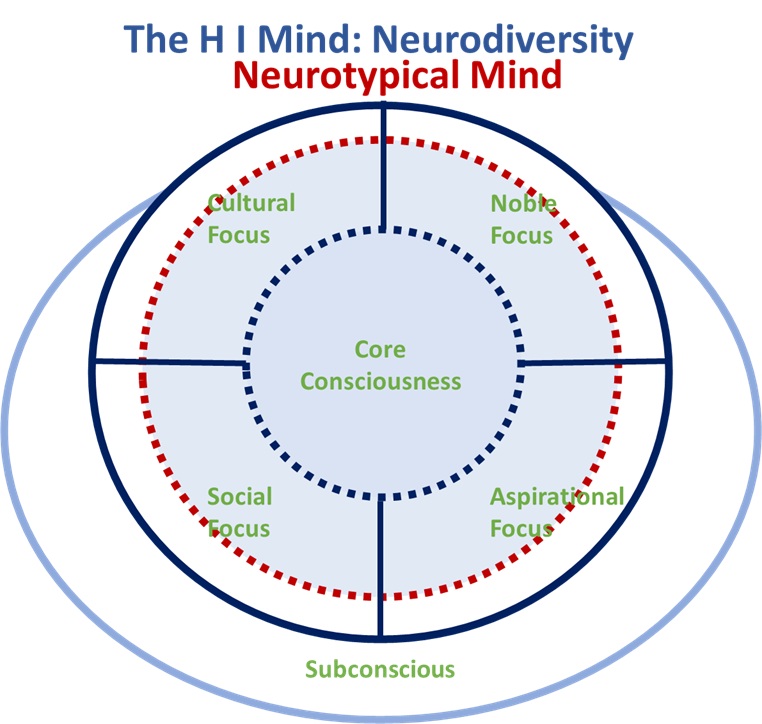
The Hemispheric Intelligence Mind Model and Neurotypical Behaviours.
The H I Mind Model can be used to represent a simple form of a neurotypical mind where all focuses can be active during typical daily activities. This represents a form of average level of brain activity across a range of different tasks. Perhaps more importantly, this balance of activity and capability across all Focuses can represent what we think of as a well-balanced mind, a resilient mind, and a mind that is well-adjusted to produce behaviour that has been proven over long evolutionary periods to give good and healthy survival chances.
However, during periods of cultural stress, however caused, there can be a need for at least some individuals to be able to behave differently. Assuming that this difference in behaviour is not easily predictable, it seems possible that there is a variation built into the Human mind that we now identify as different forms of neurodiversity. Neurodiverse individuals may be relatively rare and, in more primitive cultures, those with more extreme differences may have lower individual survival chances. The benefits to humanity as a whole may be considerable when diversity brings individuals with increased creativity, or dogmatism, or greater planning skills, or greater sensitivity.
The Hemispheric Intelligence Mind Model tentatively offers some ideas about how neurodiversity may be better understood as differences in how the Focuses of Mind interact together.
The Hemispheric Intelligence Mind Model and Autism.
Autism is complex and varies greatly from individual to individual. One aspect that can be highlighted in autism is an apparent reduction in social capabilities, which may be compensated for through masking behaviours or deeper social concentration. However, another benefit of reduced social skills (Social Focus) may be compensated for by an increase in selfless behaviours and understanding of the essential nature of potential problems (Noble Focus).
This form of neurodiversity may be able to contribute deeper insight and wisdom, to address issues for the benefit of all.
The Hemispheric Intelligence Mind Model and Attention Deficiency Hyperactivity Disorder.
In ADHD one apparent change is an increase in impulsivity and even compulsive behaviours. Impulsivity can be considered as active creativity with reduced self-management. Creative behaviour in the H I Mind Model is associated with the Aspirational Focus and our appreciation of appropriate behaviour is mainly associated with the Cultural Focus. An individual with ADHD may be less aware of cultural norms and more open to opportunities that might escape the notice of most neurotypical individuals.
The Hemispheric Intelligence Mind Model and Dyslexia.
The change here is away from the Cultural and Noble Focuses and towards the Social and Aspirational Focuses. Perhaps such an individual would have less interest in language-use and culturally-focused behaviour and more interest in creativity and personal wellbeing. A day-dreamer, but one that does not really care too much about their place in society nor how much they may or may not be able to influence those around them.
The Hemispheric Intelligence Mind Model and Narcissism and Paranoid Personality Disorder.
Here the shift is away from the selfless behaviours and motivations of the Noble Focus and towards the importance if self provided by the Social Focus. An individual may show behaviours that are nearly always self-serving (Narcissism), or that are overly fearful of the actions of others (Paranoid Personality Disorder), or may become compulsively manipulative of others for their own benefit (Sociopathy or Psychopathy).
The Hemispheric Intelligence Mind Model and Fanaticism and Authoritarianism.
Here the bias is towards stronger association with the Cultural Focus and away from the Aspirational Focus. This might produce a scholarly strengthening of cultural norms or knowledge but with a reduction of general creativity. Fixed expert views provide significant strengths aimed at supporting and continuing current cultural norms, a relative insistence in maintaining things as they are.
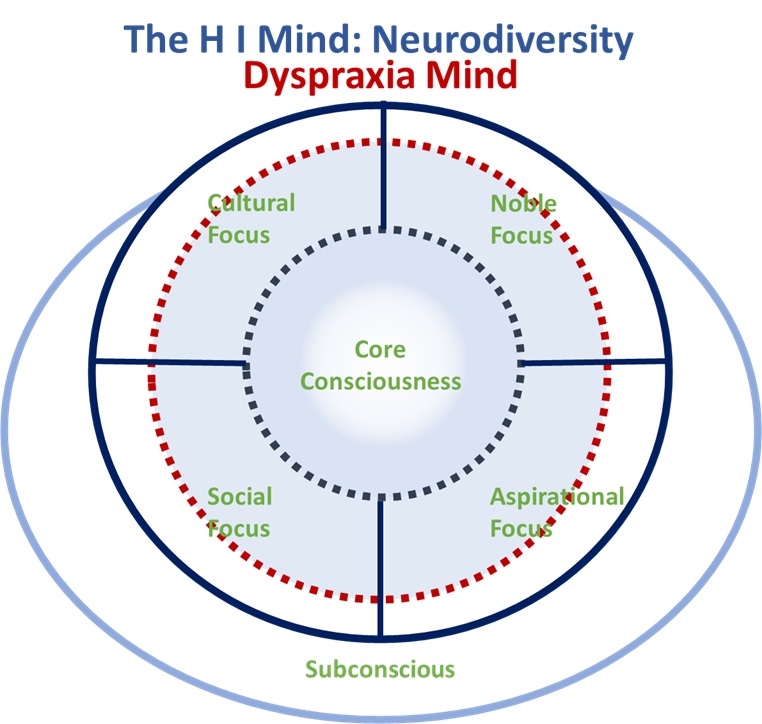
The Hemispheric Intelligence Mind Model and Dyspraxia, Dyscalculia, etc.
Essentially in this version of diversity, the Planning Focus itself, and possibly Core Consciousness, is reduced in effectiveness whilst all the other Focuses remain roughly as normal. This will show externally as a number of possible behavioural dysfunctions, including Dyspraxia (reduced language processing with creative visual thinking), Dyscalculia (reduced ability with mathematical reasoning), Intellectual Disability (reduced overall intellectual abilities or mental resilience), and perhaps other psychiatric conditions such as Bipolar Disorder and Schizophrenia.
It is too early to be able to predict if any of these conditions can be helped using this approach because the H I Mind Model is purely theoretical at this stage. Basic research and confirmation, or otherwise, of the basic model and its validity is required before any serious consideration can be given to possible future approaches to beneficial therapy or interventions